


British Road Racing in 2026 – Where it’s all at and how we’re helping

Updated: Mar 26
Spend any time reading about British road racing and you’ll probably come away with the view that the sport is shrinking and living off nostalgia. On social media, however, cycling looks bigger than it did even ten years ago.
There’s been an explosion of channels built around amateur racing and endurance challenges that pull audiences that used to belong almost entirely to traditional cycling media. Riders post race breakdowns, power files and training insights, sometimes to hundreds of thousands of people. Entire communities have grown around ultra-distance events like the TCR, Badlands and the Mountain Races (to name just a few), with many now running on application processes or lotteries. Add to that general cycling lifestyle and influencer content.
The problem is that a lot of that growth sits at some distance from the part of the sport that still depends on organisers, volunteers, and small domestic teams to keep going.

360 Stage Race, Day 1. Photo by Ellen Isherwood.
How do you run a UK road race when even a full field loses money?
Over the past decade, the domestic road calendar has gradually thinned out. Some long-standing races have disappeared altogether, while others are still going largely because a small number of organisers are willing to keep dealing with the growing complexity of putting on a race on open roads. Insurance costs have gone up, permissions are harder to secure, and the admin involved in race organisation has become heavier year after year.
There’s also a UK-specific layer to this. Road closures are expensive and often unpopular, so running races on open roads has become harder to justify. That doesn’t stop events from happening entirely, but it does narrow the margin for running them.
If we’re breaking down a National B road race – the level that makes up most of the British road racing calendar – total costs in 2024 came to £4,835. Under the 2025 levy structure, that rises to £5,553, while expected income from entries sits at around £5,040. That means operating at a loss on a full field, before factoring in all the things that don’t show up on a spreadsheet.
Most races rely heavily on volunteers with the same people often organising, marshalling, driving, and managing the event year after year. So it doesn’t take any major shock for the calendar to thin out.
A sport that's built on volatile team structures

The broader professional scene hasn’t been immune to uncertainty either, and part of the reason sits in the way cycling works as a sport.
Unlike football or rugby, cycling hasn’t really been built around stable clubs that carry identity across generations. A football club can survive changes in ownership, management and sponsorship because the institution itself is the thing people support. Fans inherit allegiances, keep turning up, and the club remains the anchor.
Professional cycling doesn’t generally work like that. Teams are usually built around title sponsors, and when those sponsors leave, the team often disappears or comes back under a completely different identity. Riders move on, staff disperse, and the whole thing starts again under a new name. That model has produced some iconic teams over the years, but it also means cycling has never had the same kind of institutional stability as other sports.
At National level, even results don’t guarantee stability – we all witnessed Muc-Off-SRCT-Storck win the National Road Series and still fold after failing to secure funding for the following season. Saint Piran and Hess Cycling also followed similar paths.
It’s especially tough at that level, with riders often training and racing like professionals without being paid like professionals. Many cover large parts of their season themselves, travelling across the UK and Europe with little financial backing.
Performance at the top of the domestic scene doesn’t necessarily translate into continuity, because the underlying structure doesn’t hold it in place.
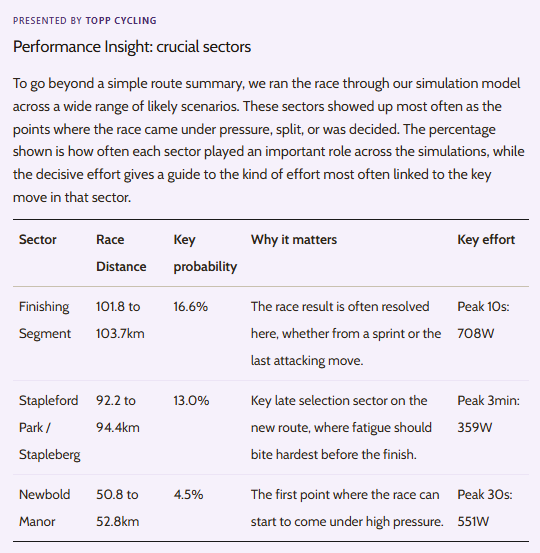
A snapshot of the Rutland-Melton CiCLE Classic race preview by Topp Cycling (crucial race sectors).
What does it cost to get serious about racing?
The cost of getting into racing doesn’t make things easier, and certainly doesn’t help grassroots racing create a strong base for the bigger pyramid.
At youth level, the headline figure of around £6,000 per child per year is already high, but even that can be a conservative estimate. In Cycling Weekly’s reporting, coach and parent Adam Brooks said that figure covered travel, overnight stays and race entries for roughly 75–85% of the national road races his children were eligible for, plus most regional races.
For those racing cyclo-cross as well, he talks about being on the road for almost 52 weeks of the year. He also pointed to the cost of individual weekends away, with events like the Isle of Man Tour easily reaching at least £1,000 once ferry travel, accommodation and race costs are included.
And that’s before properly factoring in equipment. Brooks talks about how his daughter races on a second-hand bike he bought for £700 and upgraded himself, while many of the riders she lines up against are on new carbon aero bikes.

And there’s only so much room to compromise: riders hoping to be noticed within the British Cycling pathway often need to race across multiple disciplines. That means a track bike, often £500–£1,000, and for cyclo-cross both a race bike and a pit bike, which he estimates at least £3,000 for the pair. Add to that the fact that teenagers outgrow bikes quickly, often need several replacements over those years, and then the extra layer of helmets, shoes, bike computers, indoor trainers and subscriptions… the overall cost rises fast.
Josh Tarling’s dad also talks about five-hour round trips from west Wales to Newport Velodrome twice a week, along with re-mortgaging the house to pay off the credit cards. It’s maybe an extreme example, but it does show the extent to which the sport can be inaccessible at the earliest stage.
Future formats, better visibility
If those constraints require a considered and fairly long process of change, then we should take a look at where the sport is most malleable.
Some of the growth in cycling has come from formats that avoid these pressures entirely. Ultra-distance racing, gravel events and unsupported formats don’t rely on road closures in the same way. They require less infrastructure and they scale more easily.
Road racing doesn’t have that flexibility, still depending on a structured race environment and a level of organisation that’s difficult to simplify.

So, how can the domestic racing scene attract enough attention to sustain itself, not just financially, but in terms of visibility and long-term support? That matters here because teams, races and even development pathways are closely tied to sponsorship, and sponsorship depends on visibility.
Cycling is actually very well suited to that kind of visibility because so many of its fans are also participants. We all ride our bikes, understand the training and the numbers. Watts, threshold, nutrition, fatigue – none of that feels remote in cycling in the way it might in other sports.
That closeness between participant and spectator should be one of cycling’s advantages – in how many other sports do people sit at the top of a mountain for half a day waiting for their favourite riders to ride past all in just a few seconds?
Unibet Rose Rockets is an interesting use case here, not for how it solves those structural constraints, but because it shows a different way of building that visibility from the outset. What became Unibet Rose Rockets began primarily with content and personality, and with getting people to buy into a story rather than a cycling team as such.
The YouTube channel built an audience first by showing things that bigger players often skip over – the failed attempts, the financial reality of lower-tier racing, and the messy process of trying to break through the institutional barriers that come with pro racing.
By the time the team officially launched in 2023, it already had a substantial following and quickly moved from Continental status to the second-tier ProTeam level. Instead of building a team and then hoping people would care, the audience was there from the start and had essentially bought into a cast of people and a broader narrative.
That’s much closer to the logic of other modern sports and media businesses, where attention is built through access and storytelling rather than through race results alone.
If more people knew the stories behind domestic teams, local organisers, race calendars and rider pathways, there might be more chance of building the kind of support that the rest of the sport already attracts.
Why Topp is supporting races like Capernwray
At Topp, most of what we do sits on the training side of cycling, giving more riders access to the same kind of training and coaching resources available to those at the top of the sport. But we also want to use our platform to support the parts of the sport that make racing possible in the first place.
This year, we’re sponsoring the Proper Northern Road Race at Capernwray. Races like that don’t get much attention outside the domestic scene, but they’re an integral part of the structure that gives riders somewhere to race and develop.

There’s a lot of work behind even a small domestic race calendar, and most of it comes from people putting in time and energy because they care about the sport. If we can help more of that be seen, and support the racing through better coverage, we’re proud to play a part.


Comments